
Call recording is one of the first features business owners ask about when they move to a VoIP phone system. A dispute over what a customer was quoted, a new receptionist who needs coaching, an order taken down wrong: a recording settles all of them. On most modern systems it is a switch you turn on.
Which leads to the second question, usually asked a little more quietly: are we actually allowed to do that? In British Columbia the short answer is yes, provided you tell people and handle the recordings properly. Here is the plain-English version for small businesses in Surrey, Langley and the rest of BC. This is general information, not legal advice; for anything unusual, talk to a lawyer.
Two sets of rules apply
The Criminal Code: one-party consent
Under section 184 of the Criminal Code it is an offence to intercept a private communication, but not if one of the people in the conversation has consented. This is why Canada is called a “one-party consent” country: a participant in a call can record it. It also marks the hard line. Recording a call that nobody on the call knows about, for example secretly recording employees’ calls from the back office, is not covered by that exception.
Privacy law: tell people and have a reason
For a business, the Criminal Code is only half the story. A recording of a customer is personal information, and private businesses in BC are covered by the provincial Personal Information Protection Act (PIPA), which works in much the same way as the federal law, PIPEDA. The practical standard is set out in the Office of the Privacy Commissioner of Canada’s guidance on recording customer telephone calls, which describes itself as best practice even for organisations not directly under the federal Act. In summary:
- Record only for purposes a reasonable person would consider appropriate, such as quality, training or keeping a record of orders.
- Tell the caller the call is being recorded and why.
- If the caller carries on after a clear notice, their consent is implied.
- If a caller objects, offer another way to deal with you, such as email or an unrecorded line.
- Use the recordings only for the purpose you stated.
- People have a right to ask for access to recordings of their own calls.
So “one-party consent” does not mean a business can quietly record every customer. The criminal law would not stop you; privacy law expects you to be upfront.
What this looks like on a real phone system
Inbound calls
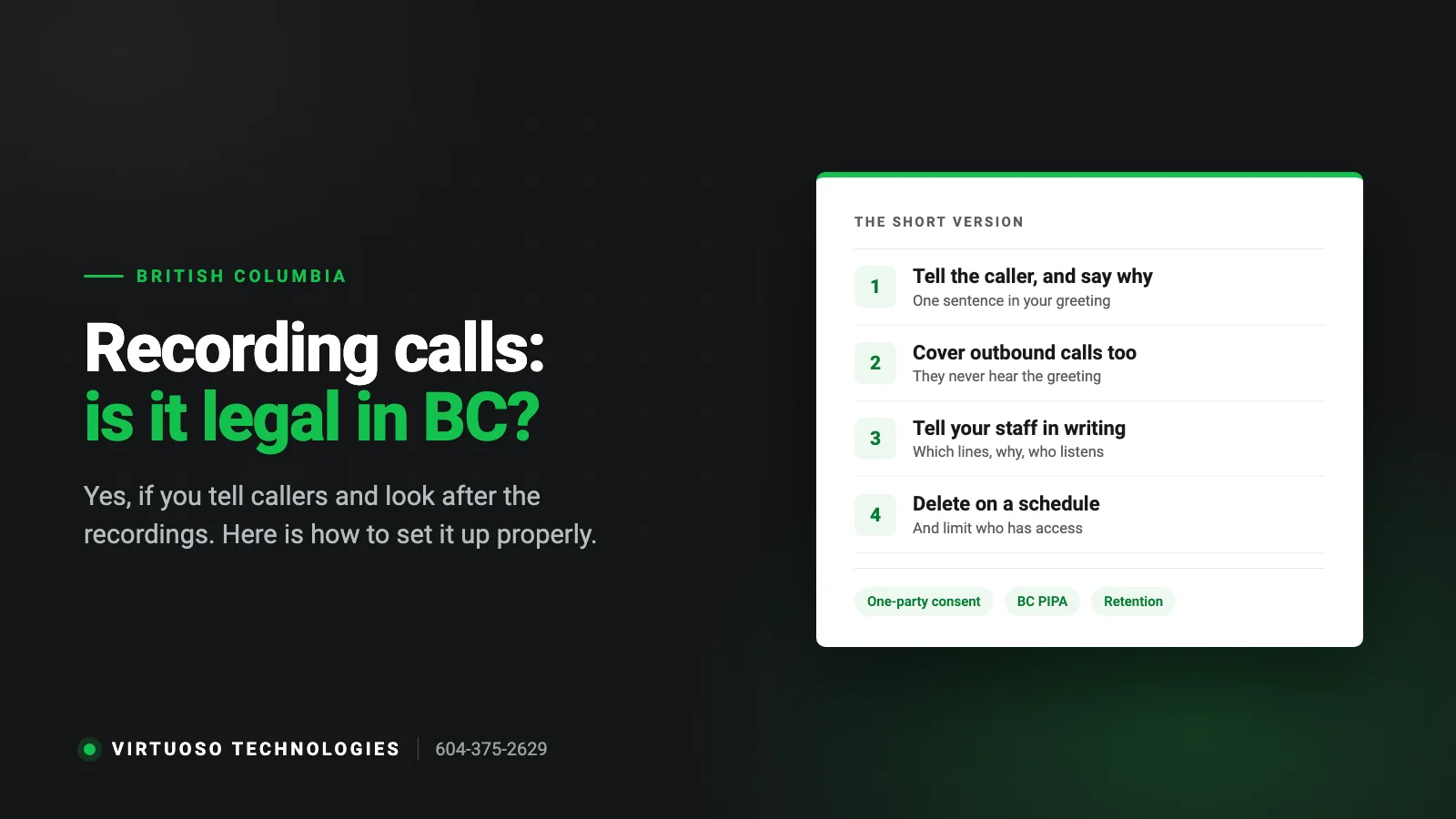
Add one sentence to your greeting, before the menu: “Calls may be recorded for quality and training purposes.” If you record for another reason, say that instead: “Calls are recorded so we have an accurate record of your order.” The announcement needs to play before the recording starts, and it needs to play on every path into the business, including the direct numbers that bypass the main menu.
Outbound calls
This is where small businesses slip. The customer you phone never hears your greeting. Either have staff say it at the start of the call (“Just so you know, this call is recorded for our records”), set the system to play a short notice, or do not record outbound calls at all.
Your staff
Employees are being recorded too. Tell them in writing: which lines are recorded, why, who can listen and how long recordings are kept. Put it in your policy handbook and have new hires sign it. Give staff a way to make a private call, such as an unrecorded line or their own cell.
Card payments
If customers read credit card numbers over the phone, those numbers end up in the recording. Card-industry security rules (PCI DSS) do not allow the security code to be stored at all. Use pause-and-resume so staff can stop the recording while card details are read out, or take payments through a secure link instead.
Storing recordings: where the real risk is
Most privacy trouble comes not from making recordings but from keeping them carelessly. PIPA expects reasonable security for the personal information you hold, and expects you not to keep it longer than you need it.
- Set a retention period and let the system delete automatically. For many small businesses 30 to 90 days covers quality and dispute purposes. If a recording is used to make a decision about someone, keep it long enough for them to ask about it. “Forever, because storage is cheap” is not a policy.
- Limit who can listen. Owners and managers, not everyone with a login.
- Protect the account. Multi-factor sign-in on the phone system’s admin portal. A breached portal full of customer conversations is a reportable headache.
- Know where recordings are stored. Ask your provider which country the data sits in. Some professions and contracts require Canadian storage.
- Be able to find a call. If a customer asks for their recording, you need to be able to locate and export it.
Businesses that should take extra care
- Medical, dental and counselling clinics. Calls contain health information, which is about as sensitive as it gets. Many clinics choose not to record, or record only a booking line.
- Law offices and notaries. Privilege and confidentiality obligations apply on top of privacy law.
- Financial and mortgage brokers. You may have regulatory reasons to record and rules about how long to keep recordings. Check with your regulator.
- Anyone calling the United States. Some US states require the consent of everyone on the call. Announcing the recording on every call keeps you safe on both sides of the border.
A five-minute setup checklist
- Decide why you are recording and write it down in one sentence.
- Decide which lines or ring groups are recorded. It does not have to be everyone.
- Add the announcement to your greeting and test every route into the business.
- Decide how outbound calls are handled.
- Set automatic deletion and restrict who can play recordings back.
- Tell staff in writing and add a line to your privacy policy.
- Turn on pause-and-resume if you take card payments by phone.
Common questions
Do I legally need the “this call may be recorded” message?
For a business recording customer calls, treat it as required. It is how you meet the notice-and-consent expectations of privacy law, and it costs you one sentence in a greeting.
Can an employee record a call on their own phone?
As a participant, the Criminal Code allows it. But if they are doing it for the business, the business’s privacy obligations still apply, and the recording now lives on a personal device you do not control. It is better to record in the phone system, where retention and access are managed.
Can a customer record a call with us?
Yes. They are a party to the conversation. It is a good reason to train staff as though every call is recorded.
Can we use recordings to train staff?
Yes, if training is one of the purposes you announced. “Quality and training purposes” covers it.
Does voicemail count?
A caller leaving a voicemail knows they are being recorded, so consent is not the issue. Retention and security still are, especially when voicemail is delivered to email.
Does every VoIP system include call recording?
Most business systems offer it, sometimes as an add-on, with settings for which users are recorded, announcements, pause-and-resume and automatic deletion. Those settings matter more than the feature itself.
Want call recording set up properly?
We set up and support VoIP phone systems for businesses in Surrey and Langley, including the greeting, recording rules, retention and secure access. New to VoIP? Start with our guide to VoIP for small businesses in Surrey and Langley. Call 604-375-2629 or send us a message.