
Your business number is on the van, the sign, the invoices, fifteen years of fridge magnets and every Google listing you have. So when someone suggests changing phone systems, the first reaction is reasonable: “I am not losing that number.”
You do not have to. In Canada, phone numbers are portable: you can move a business number from Telus, Rogers (including former Shaw Business lines), Bell or almost any other carrier to a new VoIP provider and keep using it. The process is called porting. It is routine, but it has a few traps that catch small businesses in Surrey and Langley every year. This guide covers how it works and how to avoid them. If you would like us to handle it, call 604-375-2629.
How porting actually works
You never ask your old carrier to release the number. Your new provider does the work: you sign a Letter of Authorization (LOA), they submit a port request to the current carrier, the two carriers agree on a date, and at the scheduled time calls start arriving on the new system. Until that moment, your old service keeps working exactly as before.
That last point is the important one. There is no gap where the number is “in between”. It rings on the old system, and then it rings on the new one.
What you need before you start
- A recent bill from the current carrier, ideally the latest one.
- The account name exactly as the carrier has it. “Smith Plumbing Ltd.” and “Smith Plumbing & Heating” are different customers as far as a porting desk is concerned.
- The service address on the account, which may be an old address if you have moved.
- The account number, and for cell numbers, the device details or PIN the carrier asks for.
- The name of an authorised contact on the account, who signs the LOA.
- A list of every number on the account: main line, rollover lines, fax, toll-free, the number on the old Yellow Pages ad. Decide for each one whether it is being ported, kept or cancelled.
Step by step
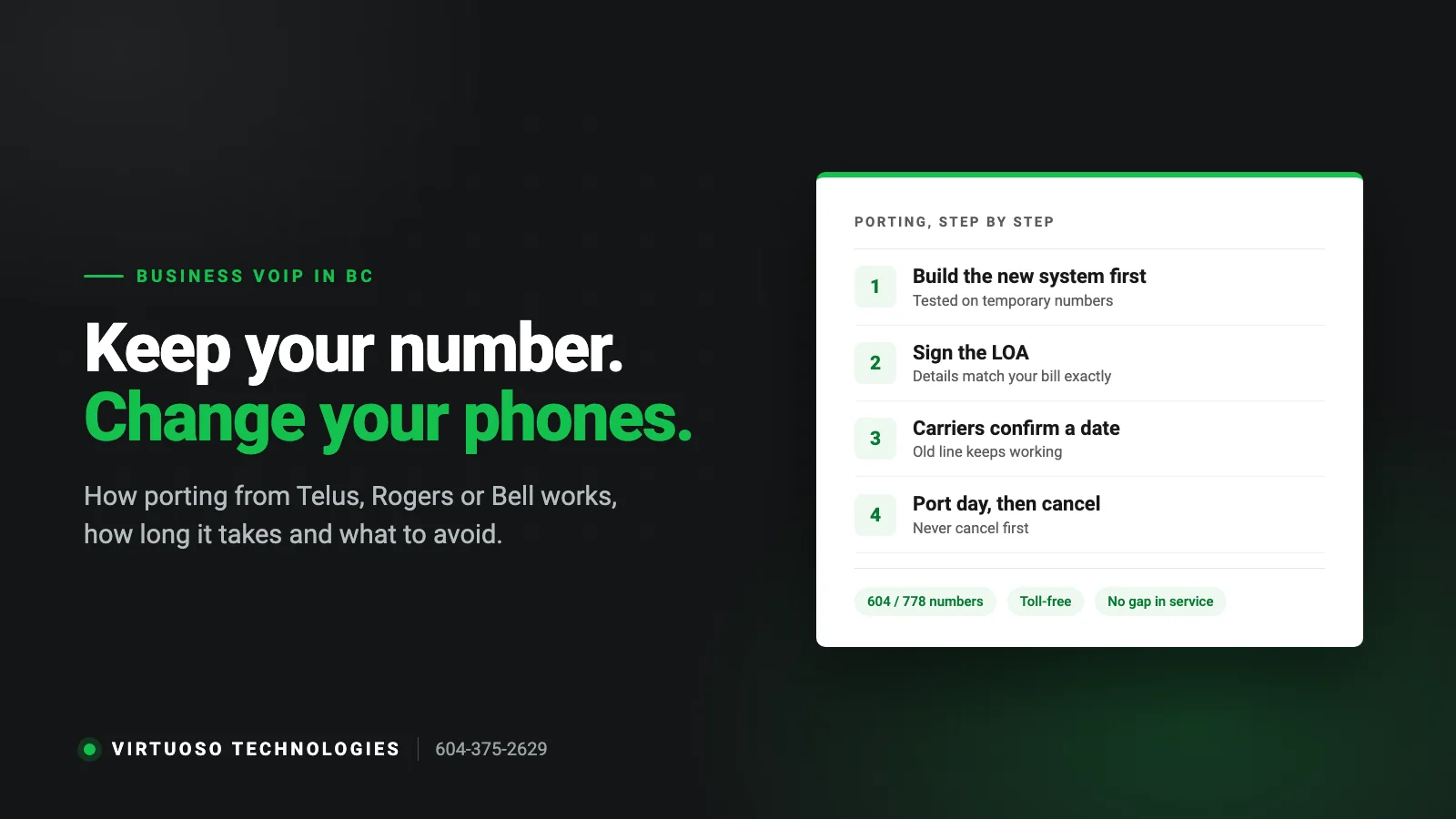
- Build the new system first. Users, greetings, ring groups and after-hours rules are set up and tested on temporary numbers while the old phones keep working.
- Sign the LOA and submit the port. Your new provider sends the request with the details above.
- Wait for the confirmed date. The losing carrier checks the request against their records and either accepts it or rejects it with a reason. Once accepted, you get a firm date and time.
- Port day. At the scheduled time the number moves. Make a few test calls from a cell phone and from a landline, and check that the greeting, ring groups and voicemail behave.
- Cancel the old service afterwards. Porting a number usually closes that line automatically, but other services on the account (internet, other lines, equipment rental) do not cancel themselves. Call the old carrier after the port to tidy up the account and return any equipment.
How long does it take?
The carriers set the date, not you and not your new provider. For a straightforward business landline, a week or two from a clean request is common; simple single-line ports can be quicker, and accounts with many numbers, toll-free numbers or contract complications can take longer. A rejected request restarts the clock, which is why getting the details right the first time matters more than anything else.
Plan for the date rather than around it: ask for a port early in the week and early in the day, so that if anything needs attention, both carriers are at their desks.
The five mistakes that cause problems
1. Cancelling the old service first
This is the one way to genuinely lose a number. A number can only be ported while it is active. If you cancel the line, the number goes back to the carrier’s pool and may not be recoverable. Never cancel before the port completes.
2. Details that do not match the bill
Most rejected ports come down to a mismatched business name, address or account number. Copy them from the bill, character for character.
3. Forgetting the contract
Porting out does not cancel a term contract. If you are mid-term with your current carrier, check what is owed before you move. It is often still worth switching, but you want to know the number first.
4. Breaking a bundle
If your phone line is bundled with business internet, porting the number can change the price of what is left or, in some cases, affect the internet service itself. Since your new VoIP phones will run over that internet connection, confirm with the carrier what happens to the internet when the phone line leaves.
5. Forgetting what else uses the line
Fax machines, alarm panels, elevator phones, gate intercoms and some debit terminals still dial out over an analogue line. Find them before the port. Each has a clean answer, such as an electronic fax service, a cellular alarm communicator or keeping one analogue line, but it needs to be arranged in advance. We cover this in our guide to VoIP for small businesses in Surrey and Langley.
Special cases
- Toll-free numbers (1-800, 1-888 and so on) are portable too, through a slightly different process with its own form.
- A cell number used as the business line. It can usually be ported to a VoIP system, so it rings the whole team instead of one pocket. The owner then gets a new personal cell number.
- Moving between cities. Because a VoIP number is not tied to a building, a Surrey business that moves to Langley, or opens a second location there, keeps the same number. You can also add a local number for the new area.
- Some numbers only. You can port the main line and let the unused extras go. Make sure the LOA lists exactly the numbers you want, and that the “main” billing number on the account is handled deliberately, because porting it can close the whole account.
- Temporary forwarding. If you need the new system working before the port date, forward the old number to a temporary number on the new system. Callers notice nothing.
After the port: a short checklist
- Test inbound and outbound calls, including from another carrier’s cell phone.
- Check that your caller ID name shows correctly on outbound calls.
- Confirm the 911 address registered on the new service is your current civic address.
- Test after-hours routing and voicemail-to-email.
- Look at the final bill from the old carrier and return any rented equipment.
Common questions
Can my current carrier refuse to release my number?
A carrier can reject a request when the details do not match its records, but an active number on an account you are authorised for is yours to move. An unpaid balance or a term contract does not give the carrier the right to hold the number, though you still owe what you owe.
Will we have any downtime on port day?
There should be none you would notice. The switch happens at a scheduled time and calls begin arriving on the new system. We build and test everything beforehand and stay close on the day.
Does it cost anything to port?
Some providers charge a small one-time porting fee per number and some include it. Ask when you get your quote, along with any early-termination charges from the carrier you are leaving.
Can we keep our 604 number if we move outside the 604 area?
With VoIP, yes. The number lives in your account rather than at an address, so it follows the business.
Can you deal with the carriers for us?
Yes. We prepare the paperwork from your bill, submit and track the port, and schedule it around your business hours.
Ready to move your number?
We set up VoIP phone systems for businesses in Surrey and Langley and manage the number port from start to finish. Send us a copy of your phone bill and we will tell you what the move would involve. Call 604-375-2629 or send us a message.