
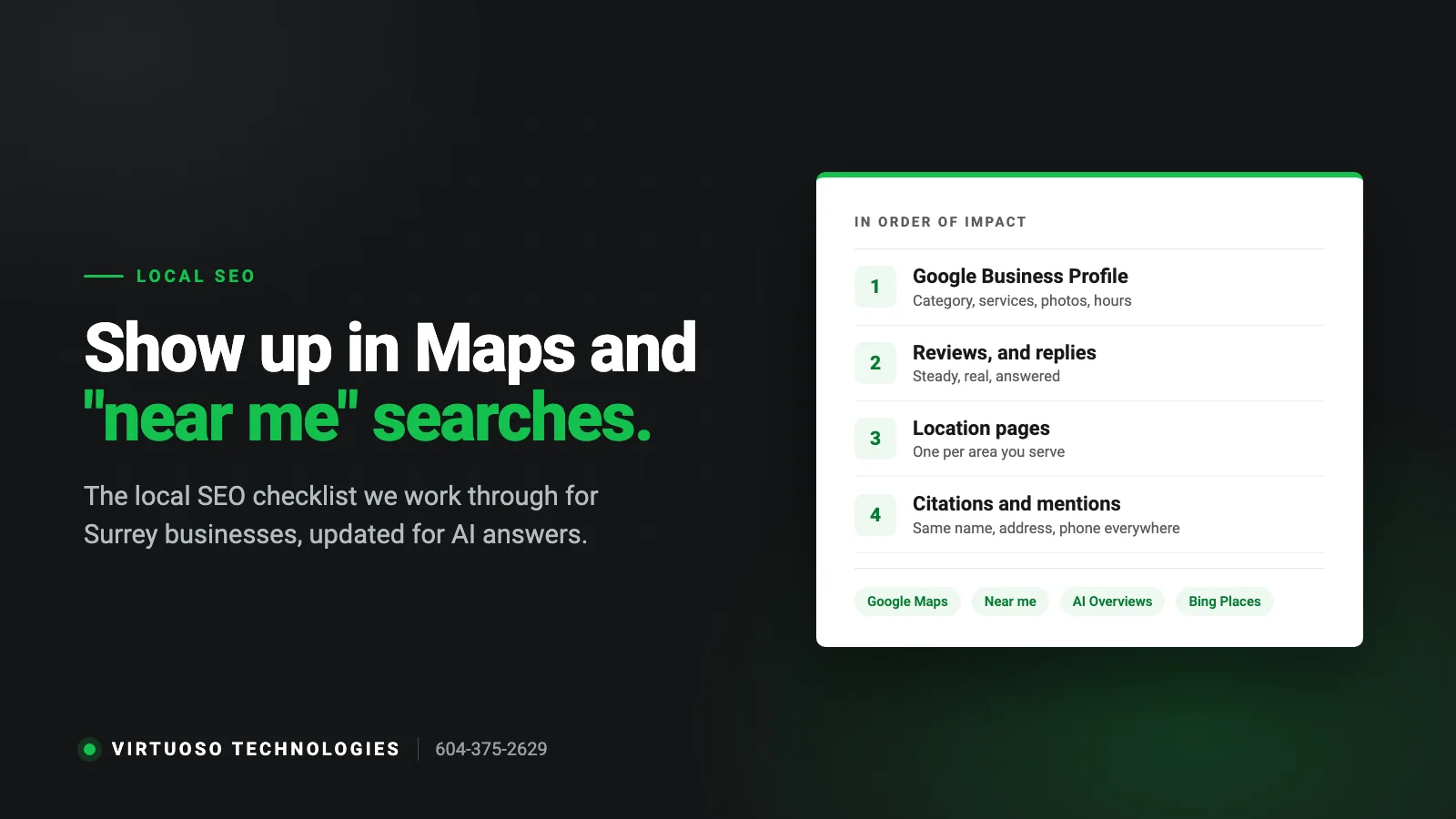
When someone in Surrey searches “electrician near me” or “accountant Newton”, Google shows a map with three businesses before anything else, and increasingly an AI-written summary above that. Whether you are in that map pack is decided by three things Google has named openly: relevance (do you do what they searched for), distance (how close you are to them), and prominence (how well known and well reviewed you are). Almost everything on this checklist is a way of improving one of those three. Work through it in order; the early items do most of the work.
1. Google Business Profile: the foundation
Your Google Business Profile (GBP) is the listing that appears in Maps and in the panel on the right of search results. It is free, it matters more than anything on your website for local searches, and most small business profiles are half finished.
- Claim and verify it, and make sure only people who should have access do. Remove the former marketing agency.
- Choose the right primary category. This is the single most important field. “IT support and services” and “Computer repair service” rank for different searches. Pick the one that matches what you most want to be found for, then add secondary categories.
- Fill in services with a description for each, using the words customers use rather than your internal names.
- Hours, including holiday hours. A profile that says “open” on a stat holiday and is not costs you a review.
- Photos, real ones, regularly. The building, the van, the team, the work. Profiles with recent photos get more clicks, and they are what AI summaries pull from when describing your business.
- Service area. If you go to customers, set the areas you actually cover: Surrey, Langley, White Rock, Delta and so on. If customers come to you, make sure the pin is on the right door.
- Use the Q&A and posts. Answer the questions you get on the phone in the Q&A section yourself. Post an update every few weeks; it is not a ranking factor on its own, but it keeps the profile alive and gives Google fresh text.
2. Reviews: steady, real, and answered
Reviews are the biggest part of prominence, and they are what AI answers quote when they say a business is “highly rated for responsiveness”. Three rules. First, ask every satisfied customer, at the moment they are happiest, with a direct link to the review form; a steady trickle beats a burst. Second, never buy or fake them; Google removes them and the penalties are worse than having few. Third, reply to every review, including the bad ones, briefly and politely. The reply is read by the next hundred customers, not the one who wrote it. Our guide on SEO services covers how we set this up as a routine rather than a campaign.
3. Name, address and phone: identical everywhere
Google cross-checks your business details across the web. If your website says “123 King George Blvd”, your Facebook page says “123 King George Boulevard” and an old directory lists the previous phone number, that inconsistency erodes trust. Pick one exact format and use it on the website footer, GBP, Facebook, LinkedIn, Bing Places, Yelp, the BBB, YellowPages.ca, 411.ca, the Surrey Board of Trade and any industry directories. Then find and fix the old ones; a search for your phone number in quotes turns most of them up.
4. The website: tell Google where you are
- City in the title and first paragraph of the homepage and each service page: “Managed IT services in Surrey, BC”, not just “Managed IT services”.
- A location page for each area you genuinely serve, with something real on it: the neighbourhoods, the kind of customers you have there, how quickly you can be on site. Do not create twenty near-identical pages with the city name swapped; Google recognises that and so do people. See our Langley page for the shape.
- Local business schema on the site, with the address, phone, opening hours, map coordinates and service area, so search engines and AI systems read the facts without guessing.
- An embedded map and the full address on the contact page, and the phone number as a tap-to-call link.
- Fast on a phone. Local searches are mostly mobile. A slow site loses the click even when it ranks.
- Answer local questions in content. “How much does X cost in Surrey”, “do you need a permit for Y in BC”, “best time of year to Z in the Lower Mainland”. These are the searches AI now answers directly, and it answers them from pages that answer plainly.
5. Citations, mentions and links from Surrey
Prominence is partly about how often the wider web mentions you. Beyond the directories above, the mentions that count are local: the Surrey Board of Trade or Langley Chamber member listing, a sponsor line on a minor hockey team’s site, a supplier who lists you as an installer, a local news item, a Reddit thread where a real customer recommends you. These take effort and cannot be bought in bulk, which is exactly why they work.
6. Do not forget Bing
Bing has a fraction of Google’s searches, but Microsoft’s Copilot and several AI assistants draw on Bing’s index and on Bing Places. Claiming and completing your Bing Places listing takes twenty minutes (it can import from Google) and puts you in front of the AI tools that do not use Google at all.
What changed with AI search
Google’s AI Overviews and assistants such as ChatGPT and Perplexity now answer “who is a good IT company in Surrey” directly, with a shortlist and a sentence about each. They build that answer from the same sources: Google Business Profiles, reviews, directory listings, and web pages that state facts plainly. So nothing on this checklist is wasted; if anything, reviews, consistent business details and plainly written pages matter more, because the AI quotes them. Two practical additions: keep the profile description and the website’s first paragraph factual and specific (what, where, since when, for whom), and make sure the business is described the same way on every platform, because the AI is checking that it is the same business.
A monthly routine that keeps it working
- Ask for reviews from the customers you finished work for. Reply to any new ones.
- Add a few photos to the Google Business Profile and post one update.
- Check the profile for suggested edits, wrong hours or questions in the Q&A.
- Look at Search Console: which local searches are growing, which pages are getting impressions but no clicks (usually a title problem).
- Once a quarter, search your phone number in quotes and fix any listing with old details.
That routine takes an hour a month and does more for a Surrey business than most paid campaigns. If you would rather someone else did it, our local SEO service does exactly that and reports on it in plain English.
Questions Surrey business owners ask us about local SEO
How long does local SEO take to work?
Fixing a Google Business Profile, choosing the right category and correcting listings can move a business into the map pack within a few weeks. Building reviews, location pages and local mentions to hold a position against established competitors takes several months. Expect visible change in one to three months and durable results in six to twelve.
Why does my competitor show up in Google Maps and I do not?
Usually one of three things: their primary category matches the search better, they have more and more recent reviews, or the searcher is physically closer to them. Compare categories and review counts first; those two explain most of it. Distance you cannot change except with a real second location.
Do I need a location page for every city in Metro Vancouver?
No. Make pages only for areas where you genuinely work and can say something specific. A page for Langley that mentions Willoughby, Walnut Grove and how fast you can be on site is useful; twenty pages that differ only in the city name look like spam to Google and to customers.
Do Google reviews affect ranking?
Yes. Review count, recency, rating and whether you reply all feed into prominence, and the words customers use in reviews help relevance (“they fixed our Wi-Fi in Cloverdale”). Reviews also appear in AI-generated summaries, so they influence the decision even after you rank.
How do I show up in ChatGPT or Google’s AI answers as a local business?
The same way you show up in Maps, because the AI systems draw on the same sources: a complete Google Business Profile, plenty of genuine reviews, consistent business details across directories, a Bing Places listing, and web pages that state plainly what you do and where. There is no separate trick; there is being clearly and consistently the same business everywhere.
Need a hand with your IT, phones or website?
We look after IT, phone systems, websites and marketing for small businesses across Surrey, Langley and Metro Vancouver. Call 604-375-2629 or send us a message and tell us what is going on.